

What Is The Reason For Heat Transfer From One Substance To Another?
How rut moves from one substance to some other
Nosotros at present ask how it is that heat moves betwixt substances. The 0thursday Constabulary of Thermodynamics tells us that heat always moves from hotter substances to colder ones. Consider these situations:
- A cup of hot cocoa loses its heat to the cup and the table upon which it sits, and to the air.
- When you touch on a cold object, it feels cold because heat is moving from your paw to the object.
- When you touch a hot object, it feels hot because heat is moving from the object into your hand.
- Did you ever observe that even on a warm day, a slice of metal at room temperature will experience cool?
- If you walk outside on a common cold, calm twenty-four hour period, y'all will lose torso heat, simply not most as fast every bit if there is air current at the same temperature.
Our goal in this section volition be to understand all of these phenomena in terms of how heat moves from one thing to some other.
Consider the figure below. The Thinker loses his body oestrus in four main ways: by conduction, radiation, convection and evaporation.
Conduction of heat is transfer through physical contact. In hotter objects, there is more atomic and molecular move. Atoms and molecules "jiggle" faster and more wildly. When a hot object touches a colder object, its surface atoms and molecules bang into those of the cold object, causing them to jiggle faster — they oestrus up. This will continue until both objects are the aforementioned temperature, or are in thermal equilibrium, one having lost some heat and one having gained an equal amount. At thermal equilibrium, the oestrus flow rate is the same in each management.
Conduction is one of the fastest means to transfer heat. When yous're camping, for instance, you can become hypothermic at night - even on a warm night, by sleeping directly on the ground. The ground temperature is usually quite a fleck cooler than your body temperature, therefore oestrus will flow from you to the ground. That'southward why an essential piece of camping gear is some sort of sleeping pad to insulate you from the basis. But what does it mean to insulate?
Insulation
A thermal insulator is a cloth through which heat does not transfer easily. Conduction relies on direct transmission of the atomic jiggling that is rut. If the atoms of a substance are tightly packed, then that jiggling is efficiently transmitted from one atom/molecule to another across information technology.
Such a substance is a good conductor of heat, and a poor insulator. See the left panel of the figure below. An extreme example of this kind of substance is diamond. Diamond is a well-nigh perfect tetrahedral lattice of carbon atoms. When one cantlet vibrates, others in the fully interconnected lattice "experience" it nearly instantaneously and transmit the vibration to the next atom in the line.
A meliorate situation would be the same kind of order, but with more open infinite. Now the jiggling has to exist transmitted over a more than convoluted path with more branch points into which it can split and dissipate (2nd frame below). Plastics and wood are rough examples of this kind of insulator.
Fifty-fifty better are substances with few connections between molecules. This might be the case for something similar pinkish fiberglass insulation, which is made of long, sparse drinking glass fibers spun in such a way that at that place is a tremendous amount of empty infinite between them.
The best insulator (below right) would exist a vacuum or near vacuum, where most of the atoms/molecules have been removed (in that location's one left). If there's nil to transmit jiggling from one substance to another, it won't be transmitted. Vacuum thermos bottles work on this principle.
We accept established that heat is merely the internal free energy of the movement of atoms and molecules in a substance. When objects absorb heat, molecules vibrate with higher kinetic energy (faster). Once in a while, a molecule "relaxes" to a state of lower vibrational energy. Energy cannot only disappear, so the lost energy has to go somewhere. It is radiated out into the world, by and large every bit infrared light, a kind of electromagnetic radiation.
The hotter an object, the more than energy it radiates. Think of a red-hot piece of metal. As the temperature of an object increases, the frequency of electromagnetic radiation that information technology emits shifts upward. Higher frequency (and shorter wavelength) means higher energy.
Very hot objects glow ruby, then blue, then white equally the temperature increases. This phenomenon is known as blackbody radiation.

Photograph: Fir0002/Flagstaffotos (Wikipedia Commons)
An object doesn't demand to glow with visible low-cal to radiate estrus. You give off heat only sitting there. In fact, a human beingness is in thermal equilibrium with her/his surroundings at virtually 72˚F.
That means your basic metabolism pumps out enough heat to heighten you to normal torso temperature, 98.6˚F but by virtue of you lot being alive.
Examples of radiative heat loss are all effectually. If yous don't accept baseboard radiators in your house, at least you've probably seen them (correct). They are built to maximize the surface area from which heat tin escape. Heated water in a metal pipe warms attached metallic fins, which provide aplenty surface area from which radiated estrus can escape.
Estrus radiates from any object, provided the environment around it is cooler. A bang-up deal of oestrus radiates from the man head in common cold weather, which is why wearing a hat can get a long way toward keeping you warm.
Wearing insulating wearable can assistance to keep radiated rut trapped next to the pare. The function of warm wearable is to continue radiated rut in, continue current of air out (see convection below) and to provide an insulating hedge against conductive cooling.

The speed of heat transfer: Thermal gradients
The larger the difference in temperature between two objects, the faster heat will transfer from the hotter one to the cooler one.
The deviation in temperature between two objects is chosen a thermal gradient (gradient = slope). The steeper the thermal gradient, the faster the flow of heat. For example, if a hot object is placed into a container of warm water, the hot object will lose heat to the water at some rate. Merely if the aforementioned object is placed in water ice-cold water, not just will more than heat transfer, it will transfer more quickly, in proportion to the departure in temperature (which of course is changing).

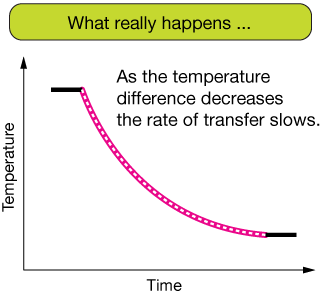
The rate of rut transfer between two objects is proportional to the temperature gradient and to the amount of expanse through which the conduction occurs. The figure beneath shows the estrus transfer as the temperature of a hotter object transfers heat to a cooler ane. Nosotros assume, for the graph, that the mass of the hotter object is very minor compared to the libation object, so that the temperature of the libation object doesn't change appreciably - it is an "infinite heat reservoir."

Of class, equally the temperature difference betwixt two substances decreases, the rate of heat transfer slows down. This leads to the curved graph on the right. The slope of the curve is steep when the temperature difference is large (fast heat transfer), just less steep as the difference decreases (slower heat transfer).
The equations that model such heat transfer are a production of differential calculus, and then I won't talk over them here. Meet, for case, Newton's Law of Cooling.
Take another look at our Thinker. Without any air movement, the body radiates heat – like it always does. Over time in however air, a "blanket" of estrus will form effectually the body equally radiated estrus warms air molecules. Now the temperature of the air just in a higher place the body is warmer than the ambience temperature, so the thermal slope is less steep and estrus loss slows down.
Simply turn on some air current and blow those layers of heated air abroad and we end up with the steepest possible thermal gradient: ~37˚C (98˚F) peel right next to colder air.
A sure way to ensure the fastest possible loss of heat is to quickly blow abroad any air warmed by radiation from the body. Removing the heated air maintains the steepest possible thermal gradient, and therefore the fastest possible heat loss.
That's why freezing days tin can feel quite unlike depending on whether there is wind. This real phenomenon is what led to development of the wind-chill concept, a calibration to remind united states of america that low temperatures volition feel colder in proportion to the speed of the wind.

We know from our study of heat and the section on h2o that the latent heat of vaporization, ΔHv , of water is large. Information technology takes a meaning amount of free energy to convert water (or whatsoever liquid, but especially water) from the liquid phase to the gas phase.
Evaporation can thus exist an effective means of removing heat from something, like a torso. Humans sweat to reduce rut. Our peel cells pump h2o to the surface, our body estrus evaporates it, and information technology carries that heat away into the temper.
If you live in a very humid area, you won't be able to cool yourself as efficiently in the summer, considering sweat won't evaporate from your skin so readily. That's because the air can be nearly saturated already with water vapor.
Dogs and other mammals pant, evaporating water with estrus from their breath to cool.
Isopropyl alcohol (rubbing alcohol) is used to simulate a cooling effect on the skin. Most alcohols evaporate at temperatures below human being torso temperature (98.six˚F = 37˚C), and so they evaporate quickly from the skin, taking heat with them into the gas phase.

What Is The Reason For Heat Transfer From One Substance To Another?,
Source: https://xaktly.com/HeatTransfer.html
Posted by: kinneyyouseliked.blogspot.com
0 Response to "What Is The Reason For Heat Transfer From One Substance To Another?"
Post a Comment