

Elden Ring More Than One Character
Laptop Mag Verdict
Elden Ring's engrossing telescopic and excellent progression systems brand it the almost intricate FromSoftware RPG yet. And although it has quite a few repetitive moments, the game'southward grandiose open world and electrifying spectacle usually make upwards for it.
Pros
- +
Hit environments
- +
Wondrous exploratory freedom
- +
Breathtaking sense of calibration
- +
Bosses are relentlessly savage
- +
Invigorating combat exchanges
- +
Masterful systems arm-twist unrivaled build diversity
Cons
- -
Occasionally repetitive open up world
- -
Mini-dungeons demand more diversity
- -
Frequent enemy and dominate reuse
In my preview piece for Elden Ring, I called the game "aimless." I felt underwhelmed and boldly stated that it "occasionally echoes the vacantness seen in other open-globe titles." This claim, which was made after seven hours of play time, is no longer representative of how I feel subsequently completion.
Elden Ring offers the nearly strong sensations of grandeur I've experienced while exploring an open world. Its immense scale and sense of freedom contrasts wonderfully with the terrors that linger throughout its derelict plains. Additionally, FromSoftware presents a robust mechanical evolution to its Soulsborne formula, providing an unmatched level of character diversity, allowing the player to tackle the many creatures of this world in whatsoever mode they delight. The game suffers from some repetitive bossfights and rehashed ideas, but The Lands Between continued to surprise me until the very end.
It's certainly one of the best PS5 games, best PC games, and best Xbox Series X games to date.
Freedom and decease
Elden Ring's open-world advisedly balances familiarity, staggering spectacle, and the repose of nature. During one moment, you're trudging through a shallow lake occupied by poisonous spores when a gargantuan dragon descends onto a group of enemies surrounding a bonfire. Once a health bar appears at the bottom of the screen, every part of your trunk will shiver with fear.
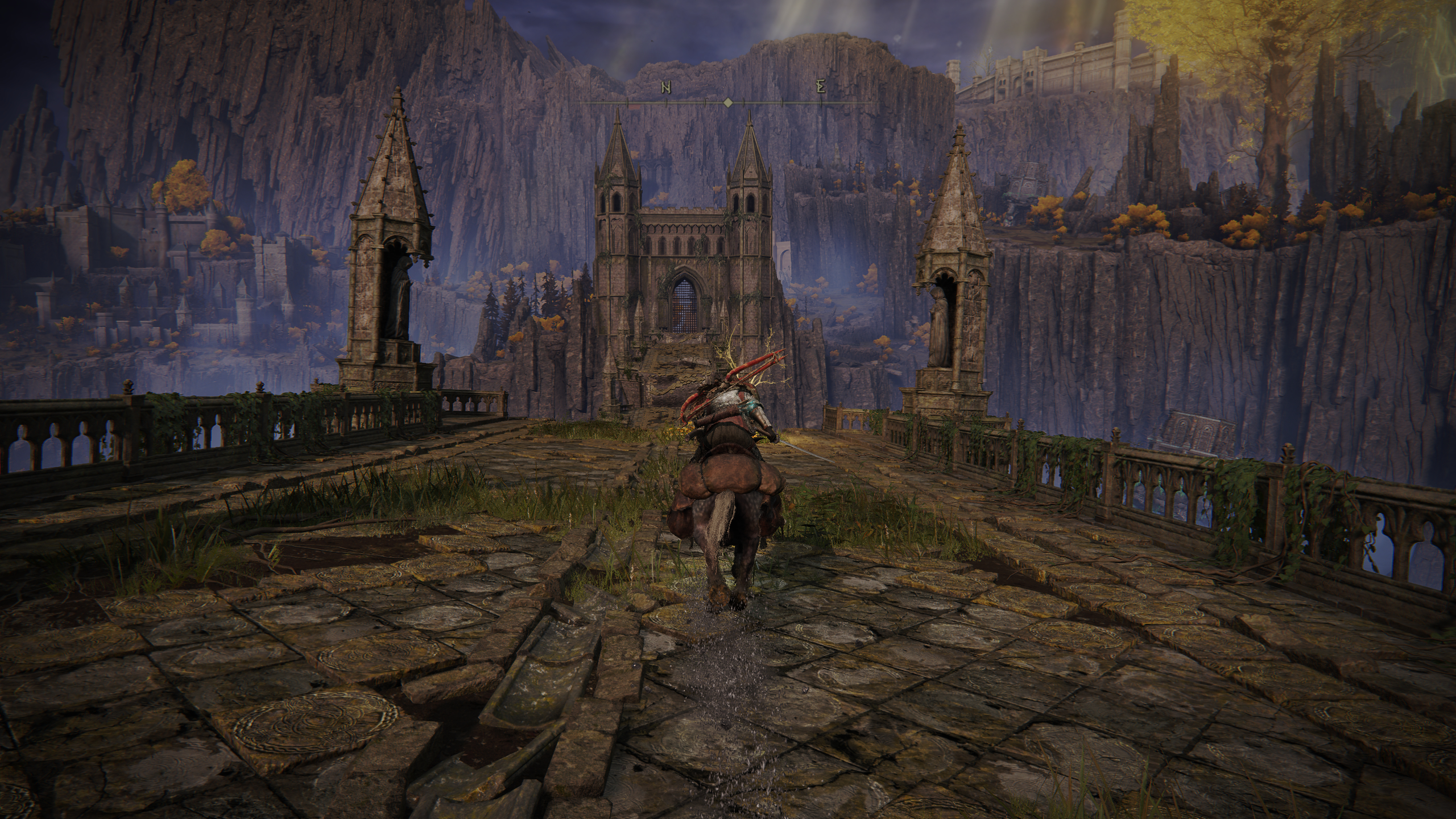
At another moment, you're traveling uphill to the peak of a mountain as currents of wind encircle your character, creating a sense of dread for what's to come as a pack of wolves descend from the trees above. And if you rush into a specific direction, a curiously placed collection of rocks erupts into a glowing stone golem that stumbles towards y'all with a murderous conviction.
FromSoftware'due south world elicits more than but grandiose spectacle. Much like Scotland's expansive landscapes, which appear to be an inspiration for the game's environments, enough of moments requite the thespian an opportunity to breathe. Elden Ring isn't all about fighting; it feels equally invigorating when casually riding through its expansive mountainous plains. The gusts of gentle current of air compliment the atmospheric music, and although the world is ripe with monsters, seeing herds of deer weave through forest thickets is calming.
When taking in an expanse from distant, it possesses the quality of a fantastical painting. Every bit the player overlooks the glowing yellow copse towering over them and a castle hanging on the edge of a cliff, the art elicits that aforementioned ethereal awareness other FromSoftware games do. But now, if the histrion sees something in the distance, they know they tin can become to it. Soulsborne has presented u.s. with huge kingdoms, massive cities, and expansive natural regions, only many were backdrops. In Elden Ring, well-nigh everything visible is accessible.
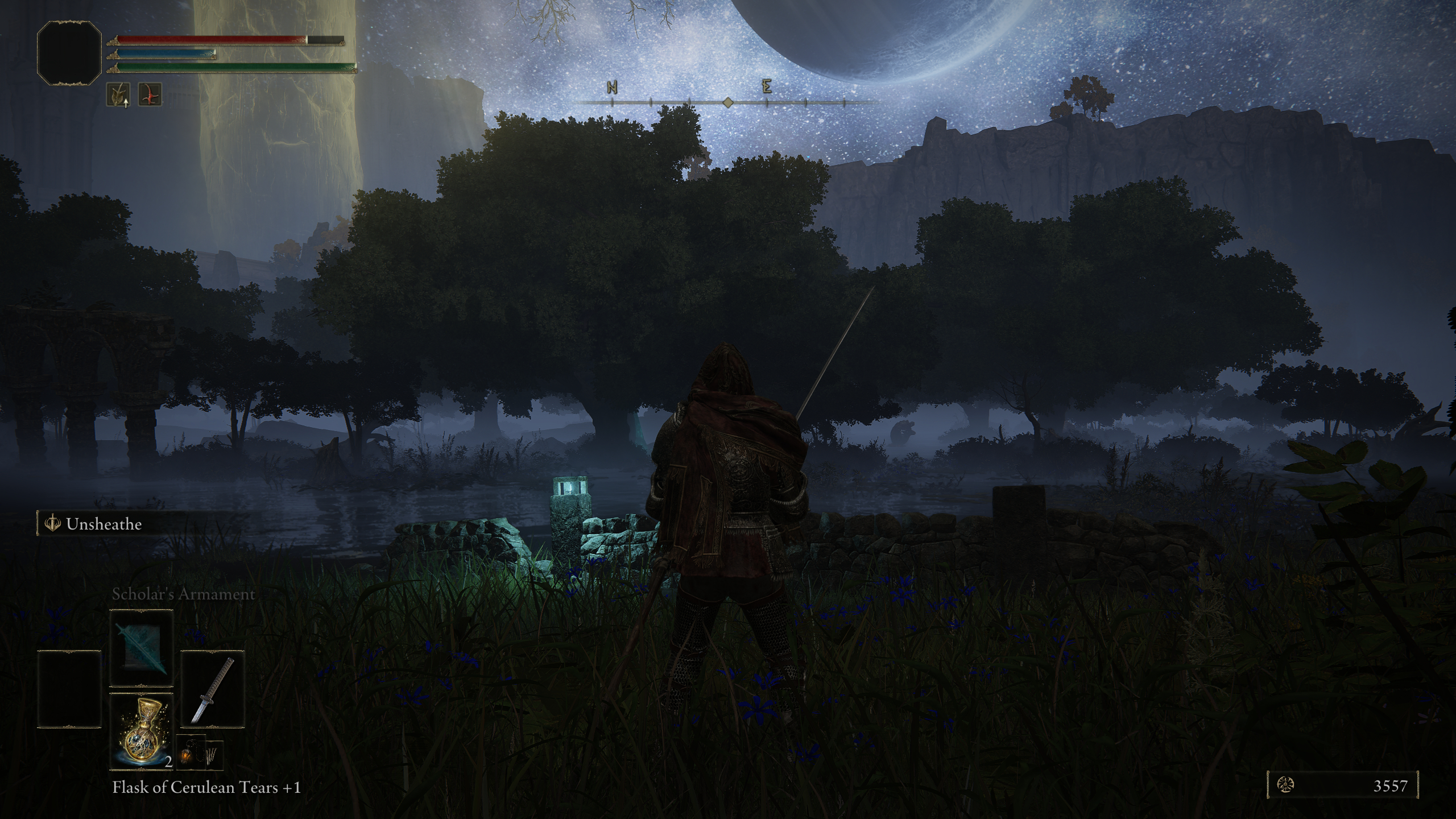
Every bit the player rides through these plains, they could easily find themselves stumbling upon an surface area equally striking as those that FromSoftware is known for crafting. And when overlooking a massive region, players will run into something interesting and wonder how they might reach it. This is a huge part of what makes Elden Ring special; where Soulsborne frequently presents areas to the player in a linear fashion, Elden Ring gives you the opportunity to discover secrets that atomic number 82 to the game's nigh memorable moments.
Revolution in atmosphere
The Lands Between harbors difficult encounters, but the gentleness of its globe makes it more outgoing than any other Soulsborne. These environments are total of wild fauna, colorful scenery, and are designed to prioritize player agency.
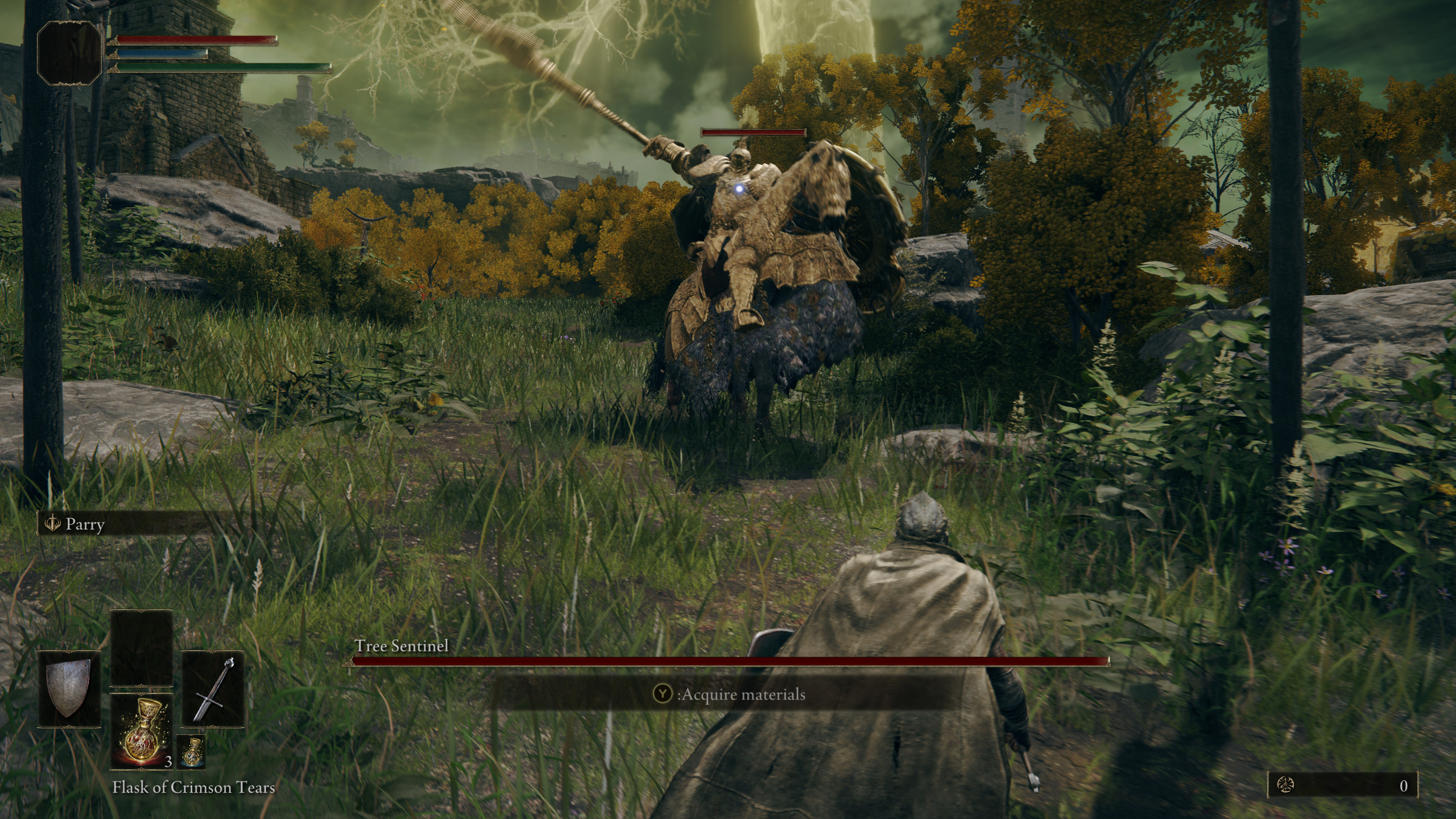
If you're stuck on a boss, you lot can completely avoid them. Elden Ring is massive, and this is evident by the placement of Tree Sentinel in the opening of the game. You tin can attempt to crush him, but information technology should be obvious that you're not gear up. Players can travel to other areas throughout Limgrave to level up and acquire equipment, weapons or spells. This approachability is enhanced past the map system, where you tin can teleport throughout the world, marker points of interest, and get a deeper agreement of the surrounding land.
The claustrophobic hopelessness of Dark Souls is rarely felt in Elden Ring. This world is liberating, and instead of tossing the players into the throes of dark fantasy, in that location'southward promise throughout The Lands Betwixt. With Elden Band, FromSoftware has traded oppression for freedom, marking a fascinating shift for the series.
Phenomenal Legacy Dungeons
Elden Ring's open-world is liberating, but FromSoftware hasn't abandoned its well-known construction. Legacy Dungeons are placed throughout The Lands Between and act similar the archetype areas you'd find in Soulsborne.
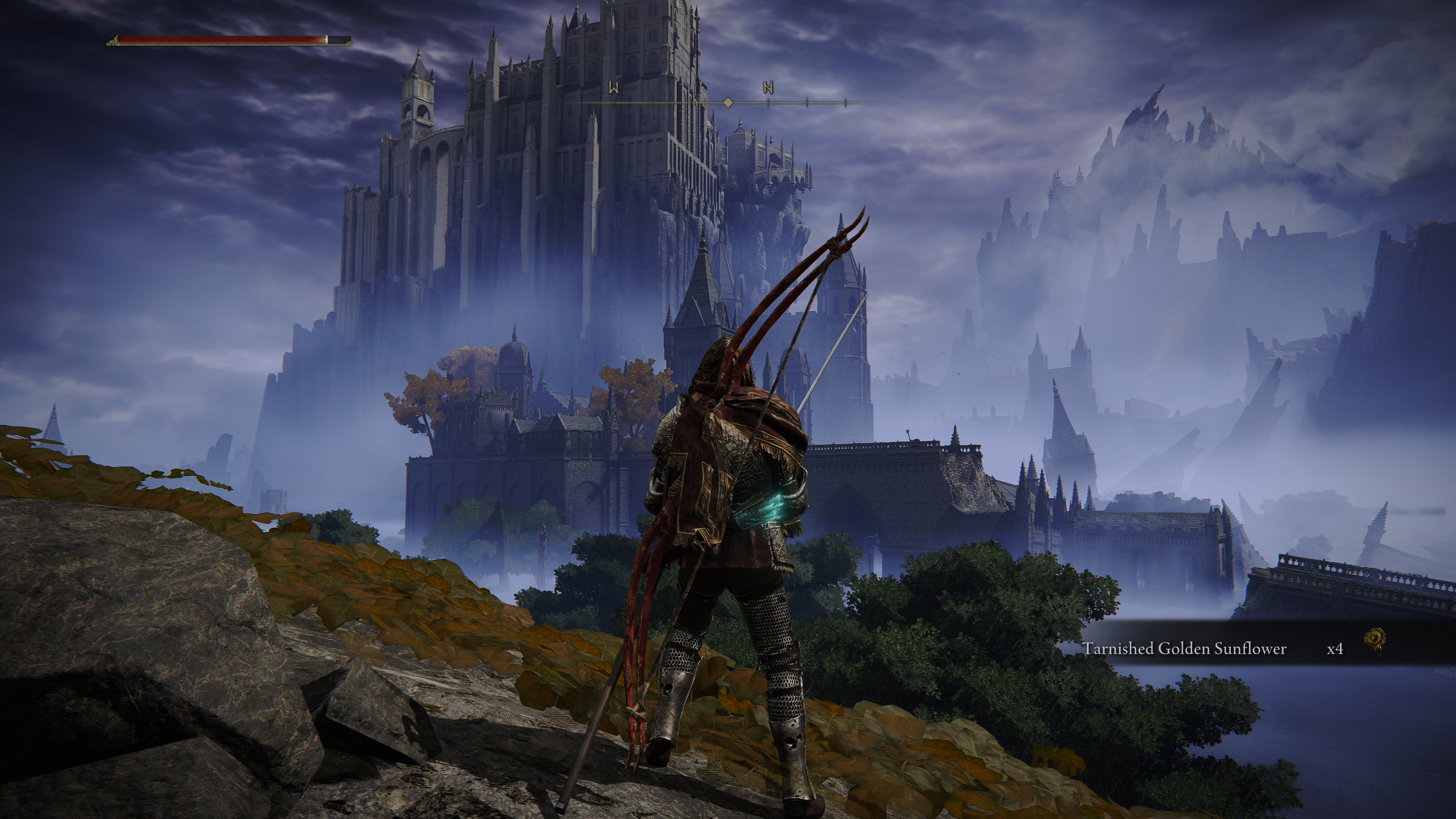
Agreement where the massive castle you just explored sits within an area adds a new level of investment, shifting your understanding of the world's scope. FromSoftware is the master of atmosphere in the medium, so it'due south no surprise that these classic areas are excellent. A player's kickoff steps upwardly towards Stormveil Castle are unforgettable. Battling a terrifying figure upon a worn bridge leading into a colossal castle as a flurry of clouds and wind encompass the arena is the level of splendor I look out of the company.
Elden Ring takes the primal designs of an open-globe game and applies those ideas to its Legacy Dungeons. At that place are hole-and-corner paths and areas to explore these spaces in a non-linear fashion. You lot tin can leap beyond rooftops, fall down into later sections of the level, or even hop up tiny bricks to find undercover items. These places commencement with an entrance and terminate with a dominate, but everything in-betwixt is up to you.
This is a huge role of what makes Legacy Dungeons first-class, as information technology doesn't but feel like a Bloodborne area has been forced into the earth of Elden Band. Instead, these spaces can be explored in unique ways, and offering striking visual moments, splendid interconnectivity inside the level blueprint, and memorable combat encounters.
Ashes of War are bright
Elden Ring introduces new systems to expand upon the combat in Dark Souls 3. Ashes of War imbue bones weapons with special skills, while simultaneously modifying what affinity that weapon has. Where previous Soulsborne games forced the player to build out the weapon a specific way from the start, Elden Ring puts an incredible amount of freedom in their hands.
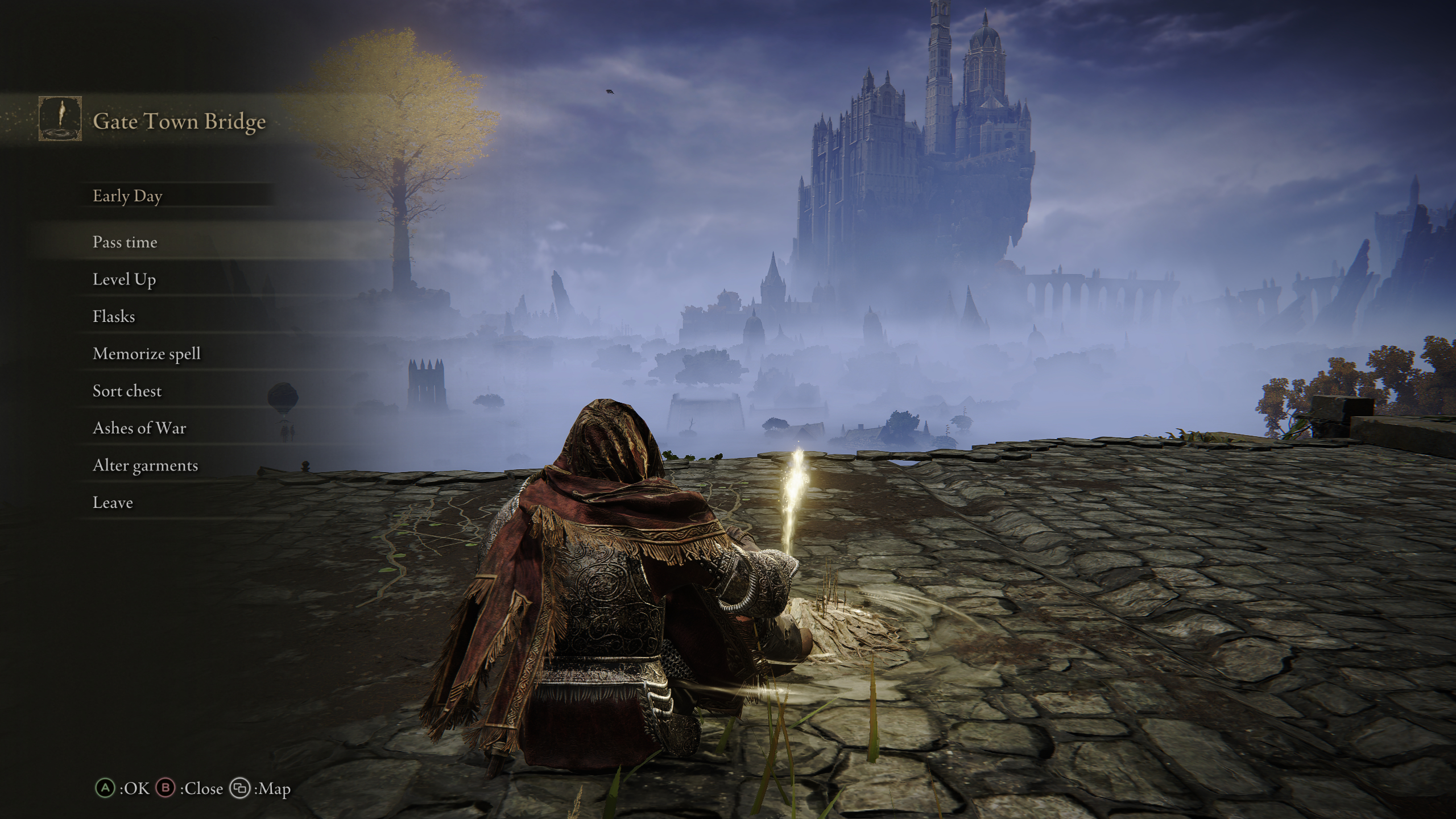
You're no longer tied to a unmarried weapon, and even if y'all decide to reset your character stats (which can be washed easily), y'all tin speedily modify the affinities on those weapons. My Uchigatana is currently set to the Keen analogousness, which ways information technology scales the best with the Dexterity stat. To change this, all I need to do is get to a Grace betoken and select the "Ash of War" carte. With the press of a button, I tin change information technology to whatever I desire at no cost, whether it be to scale with Intelligence, Faith or Force. However, this does not apply to the game's special weapons, which have Ashes of War tied to them inherently and cannot have their affinities or special abilities modified whatsoever.
Ashes of War besides act equally special skills, which the player uses to execute a special maneuver at the price of Focus Points. With my Uchigatana, my grapheme will sheathe the weapon and hold their position until I permit get, which is when they'll unleash a devastating strike against whatever is in front end of them.
Freely allowing the player to swap between Ashes of State of war, upgrade weapons in abundance, and easily change affinities gives players the opportunity to experiment more than ever before. I have eight weapons on rotation, and oftentimes jump betwixt unlike movesets and magical abilities to conquer whatever fight lies ahead. Just a few examples include a handaxe that lets my grapheme stomp on the ground and emit a wave of ice shards, a rapier that tin channel my wellness points into a devastating blood slash, and dual swords which I tin bring together to imbue with holy light.
Greater defensive complexity
Much of the hardship in Soulsborne comes from learning to dodge at the correct time, though that may be an oversimplification of the series' difficulty. Sekiro introduced more than layers by encouraging the player to parry, jump and counter.
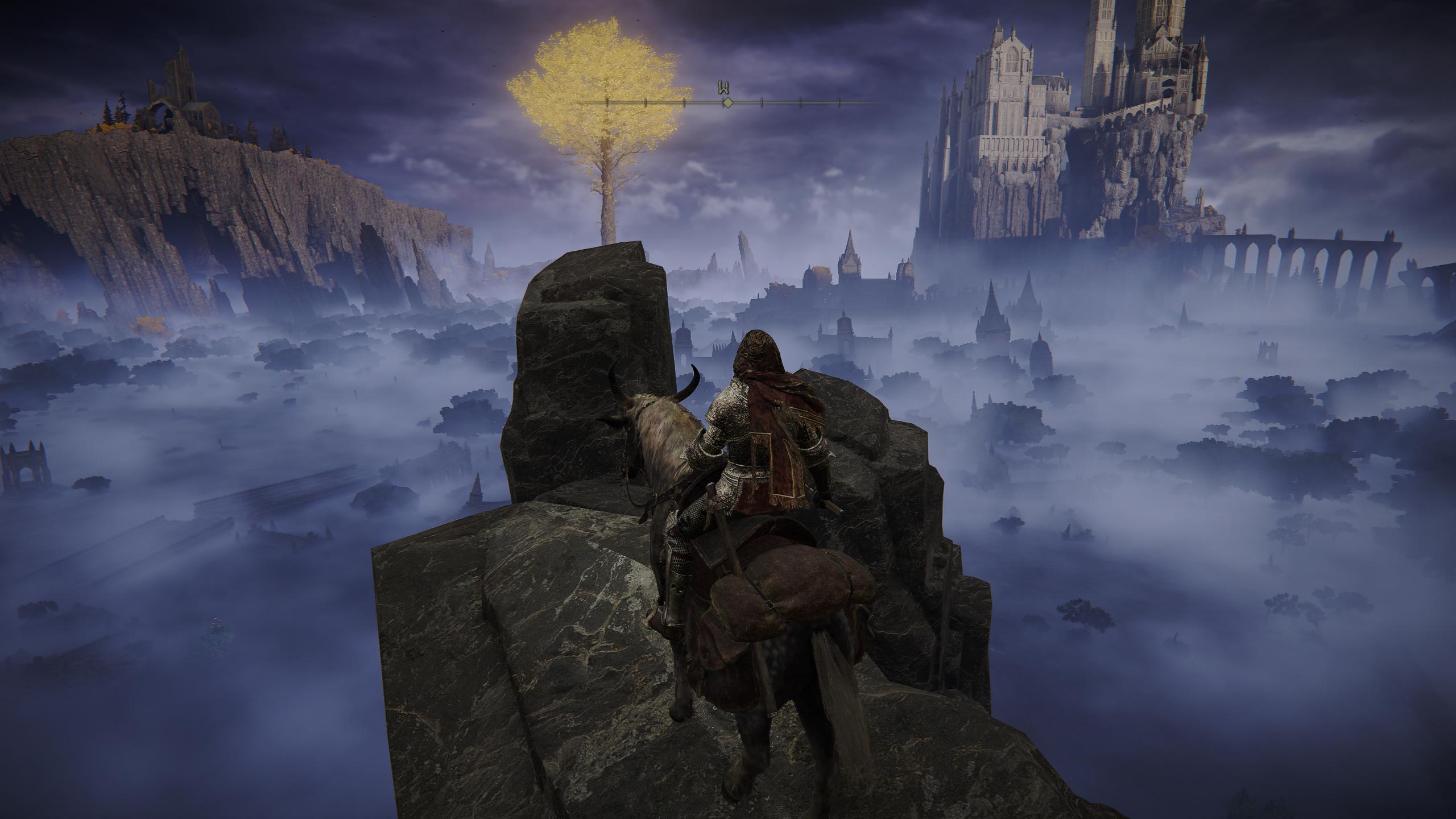
Elden Band has done something similar by bringing jumping, mounted gainsay, and crouching to the formula. Sure enemies possess attacks that erupt a shockwave beyond a broad area, and instead of rolling through these attacks, it'south safer to spring over them. While something as simple as the addition of a jump button might seem similar a silly thing to get excited about, information technology shifts the tides of battle, forcing the histrion to exist conscious of more than merely dodging at the right fourth dimension. These attacks can be rolled through, only information technology'southward far more difficult to execute than just hopping into the air.
In the open earth, y'all can mountain up at whatsoever fourth dimension, even when in the middle of a fight. If your mountain dies in battle, resummoning them will consume a Flask of Crimson Tears, which is essentially the game'south equivalent of an Estus Flask (wellness potion). Players will find themselves in situations where attacks cannot be avoided without summoning their mount. The steed won't gyre away from enemies, but its swiftness can avoid all-encompassing breath attacks and abilities targeted on specific spaces at a significantly greater step. Withal, y'all need to use this charily, every bit being knocked off your mount causes a long moment of vulnerability
Players can crouch at any fourth dimension, allowing you to hide in bushes and sneak upwardly behind unsuspecting enemies for a devastating backstab. Not only has stealth been helpful for sneak attacks, simply players can subtly cast spells that have a while to activate.
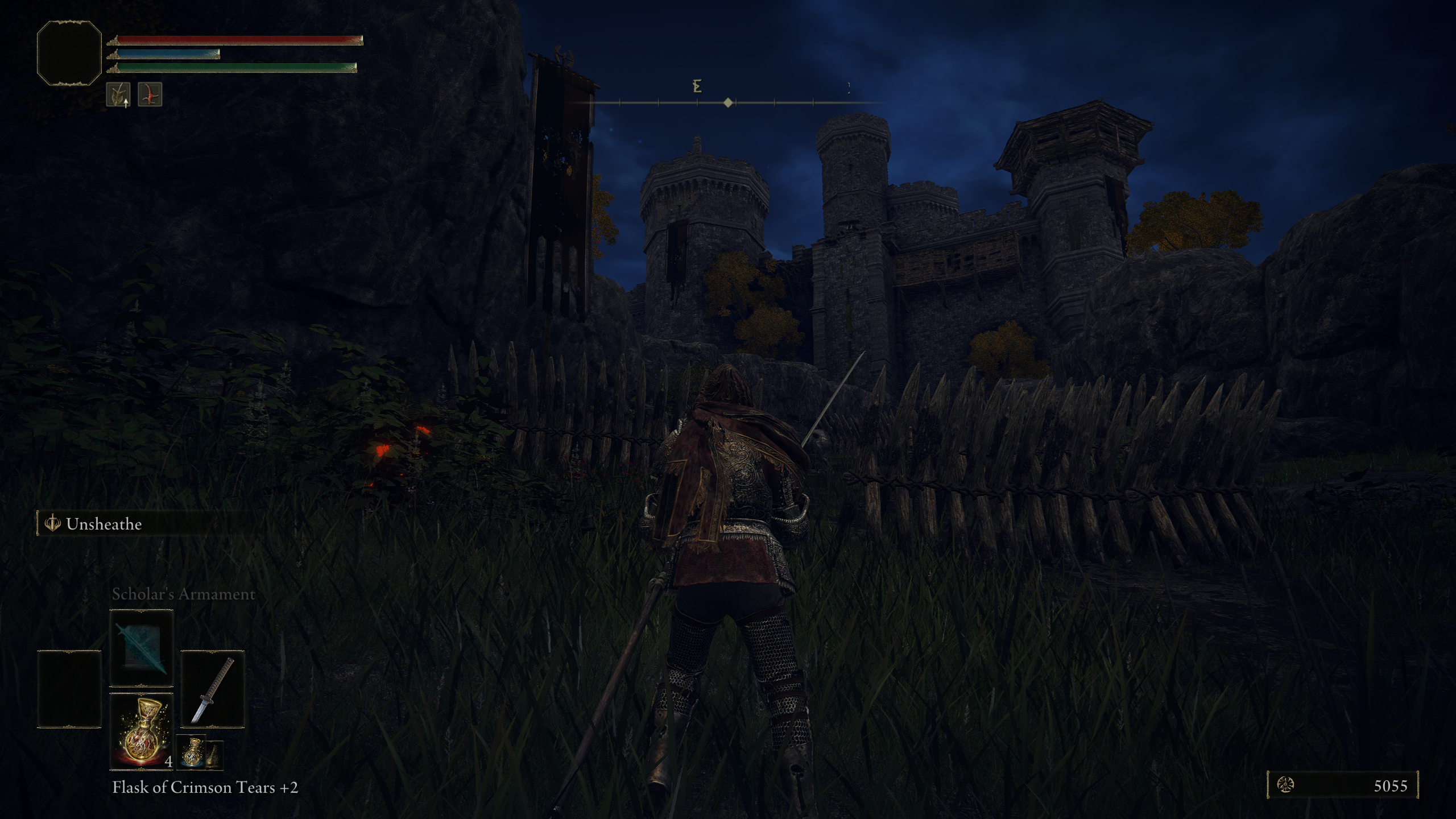
Players can also commit a counter slash when successfully blocking an attack, in which they press the heavy assault push when an enemy hits their shield. This isn't useful confronting every enemy, only it tin can exist quite important depending on your build.
Elden Ring fifty-fifty introduces Ashes, ghosts of previously encountered characters (whether they be friend or foe) to summon at the player'due south side in battle. These can exist enhanced in the same way one would upgrade a weapon, and they can be useful during hectic battles in the open globe. Elden Band is sometimes relentless in the number of enemies it throws at the actor, and although I haven't put Ashes to use very much, information technology has saved my life when a dozen enemies accept come charging at me in the plains of The Lands Betwixt.
However, sometimes these boons vary in their reliability, equally the size of Elden Band's world means the difficulty is inconsistent. You might go through a whole fort, one shot nearly every enemy, and beat the boss on your starting time endeavor. And then you lot'll trudge through a kingdom sunken in poisonous ooze and die a dozen times, with the boss absolutely whooping you into shape. I've intentionally used weaker weapons throughout less challenging moments, which isn't something I've washed in Soulsborne previously. If you're someone who lives for the difficulty, Elden Ring'due south nonlinearity volition result in some piece of cake moments. On the other hand, the game also boasts the hardest boss I've always fought.
Hyper(dominate)tension
Elden Band, similar much of FromSoftware's recent itemize, features a focus on exhilarating exchanges between the histrion and bosses. These bosses tin can be found anywhere in the world, whether it's deep within a catacombs or patrolling a random bridge in the middle of Limgrave (the game's get-go area). And to further aggrandize upon the ruthlessness of Dark Souls 3, these bosses boast movesets more unpredictable and difficult to manage than ever before.
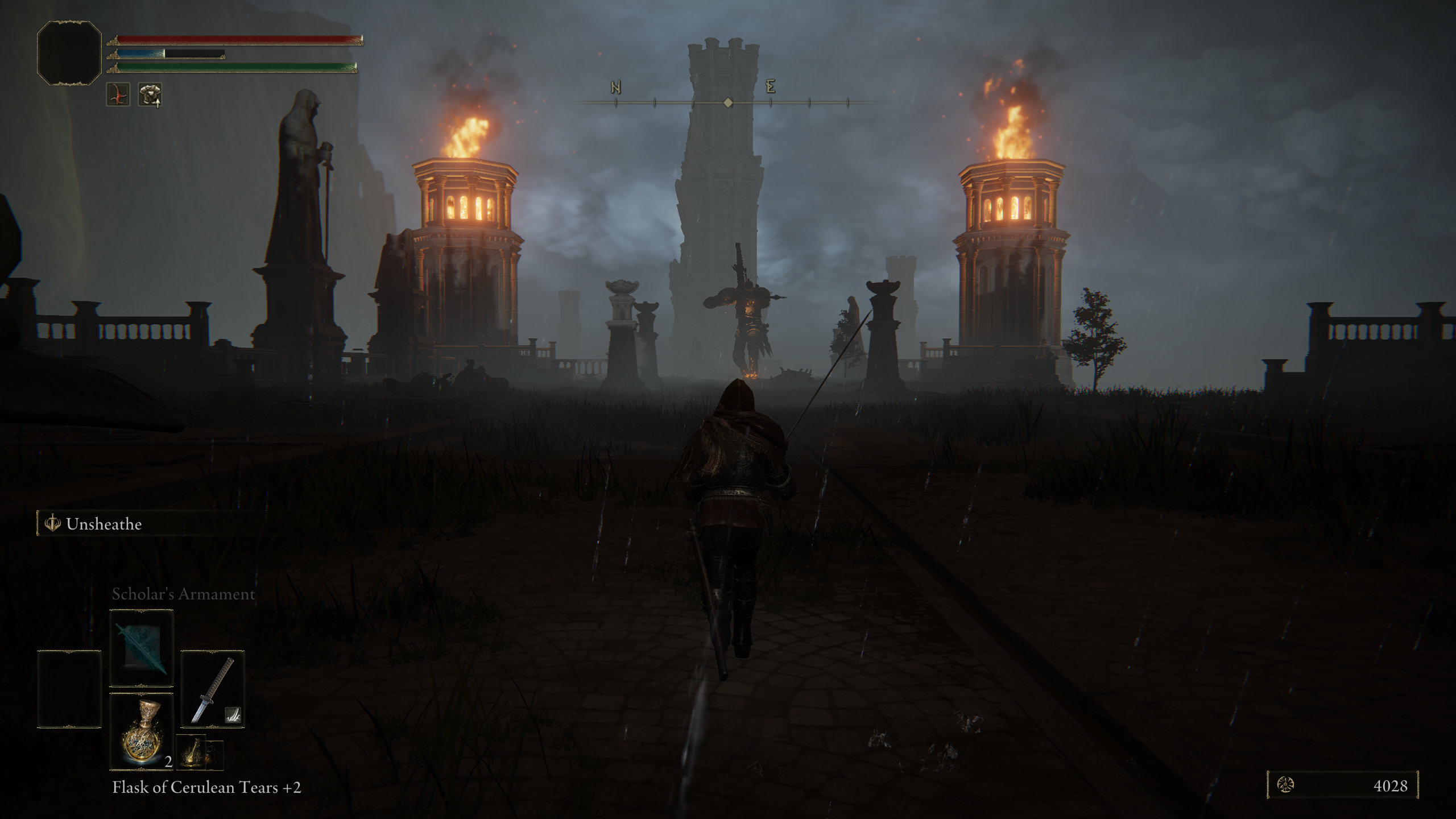
Nearly every boss (and enemy) take multiple chain attacks and also delay each strike in a mode that confuses the player to brand them scroll early. Many bosses have an cool range, and now that jumping has been introduced into the mix, players are sometimes expected to incorporate that into their fighting style.
Boss fights within the open earth are at their coolest when surrounded by thick copse, ruined structures, or barricaded campsites, as enormous dragons tin ruthlessly carve through the scenery, creating an even greater sensation of spectacle. Beyond that, the fourth dimension of day bike ensures many fights have their own unique feel to them, and a few bosses in particular can only be tackled during a specific time of twenty-four hours.
Nearly every boss roaming within the open up world is great, but you lot'll probably notice that the terrain structure can lead to some jankiness. If you lot pb a dominate a little scrap out of their designated zone, they'll disappear and reappear in their original spot. This happens when I don't even intend it to, which tin halt the momentum and break immersion. Additionally, fighting bosses on different elevations of terrain sometimes means they'll clip through the ground while they swipe at you. This hasn't happened to me a lot, only I've seen a boss get stuck more than in one case or twice.
Occasional repetition
Open-globe games rely on elements condign an expected occurrence, even when traveling to new areas. Unfortunately, this is true with Elden Ring, every bit players can expect to come across similar ruins, shacks, churches, mini-dungeons and Evergaols scattered throughout the world. Ruins are a pocket-size collection of destroyed buildings inhabited by a certain group of enemies, and if you discover the stairway leading downwards, information technology ends with a treasure chest. Sometimes, at that place'due south a dominate or an NPC, but the structure is generally identical.
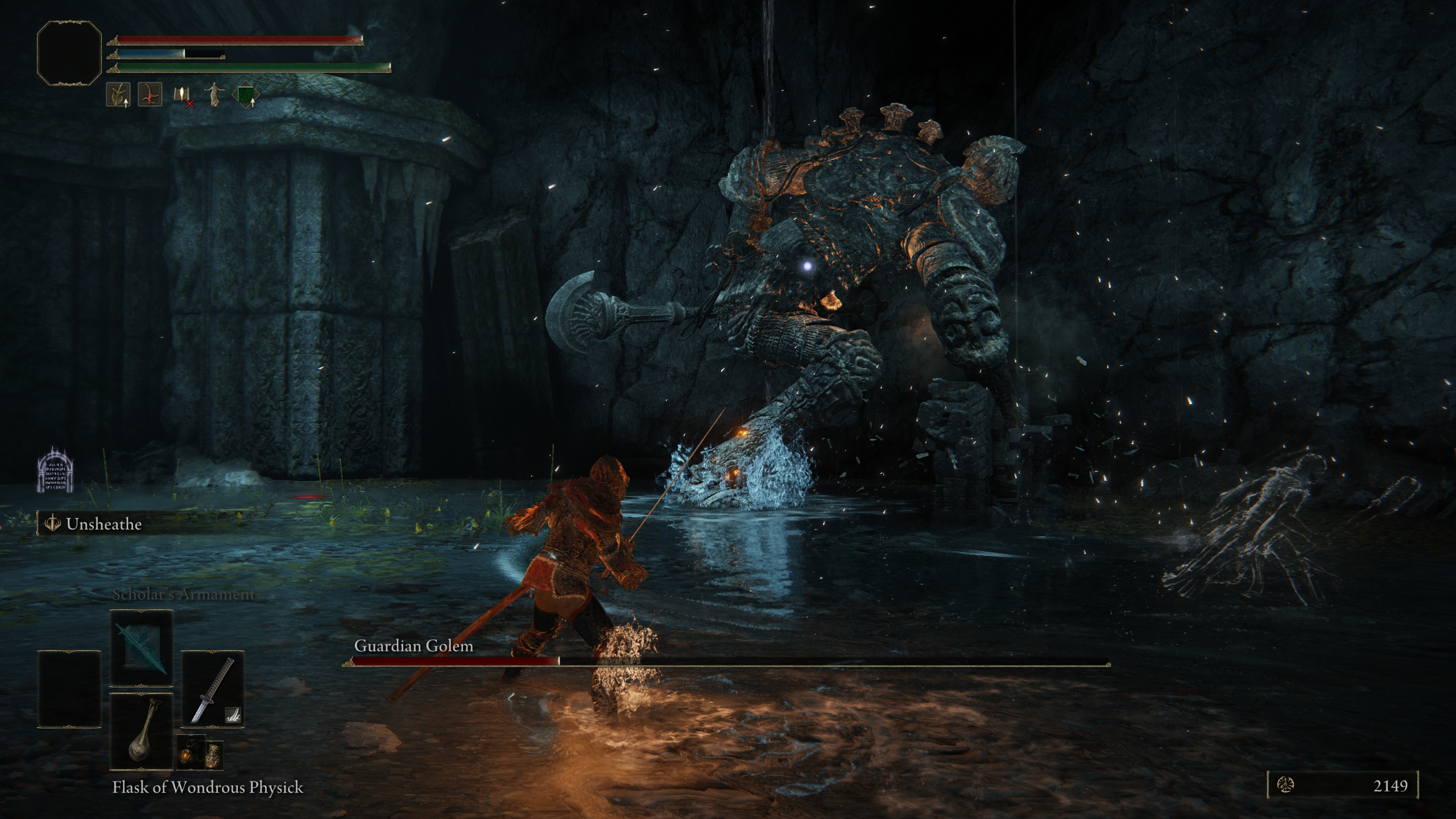
Shacks are tiny huts littered throughout the world, usually harboring a Grace point (essentially a Bonfire). There'due south as well an NPC around at that place sometimes, whether it be someone selling something or a quest giver of sorts. Similarly, Churches take the same issue, interim as a resting area with an NPC or another special item lying effectually.
Evergaols are giant platforms embedded into the ground with a glowing circumvolve in the middle. If y'all enter the Evergaol, you get taken to a misty version of that part of the world, where y'all're forced to face off against a boss. However, you lot tin can't mount upwardly or apply Ashes here, which means information technology'south more similar a sheltered run into than one that's roaming the surround. Although a few of the bosses tin be underwhelming, most of them are fun, making this my favorite of the repeated elements.
The game's mini-dungeons are the about egregious attribute, as they're modest surreptitious zones with a repetitive aesthetic that jumps betwixt a cave, mineshaft or catacombs. Like to Bloodborne's Chalice Dungeons, players run through tight spaces littered with enemies until they get to a dominate. Sometimes in that location's a twist that keeps things fresh, whether it exist the catacombs always possessing a puzzle or mine shafts getting proceedingly more labyrinthian. Just towards the end, I felt null but burnout whenever stumbling upon one. These mini-dungeons need more diversity, especially since many of them terminate with an upscaled version of a regular enemy boasting a bigger health bar.
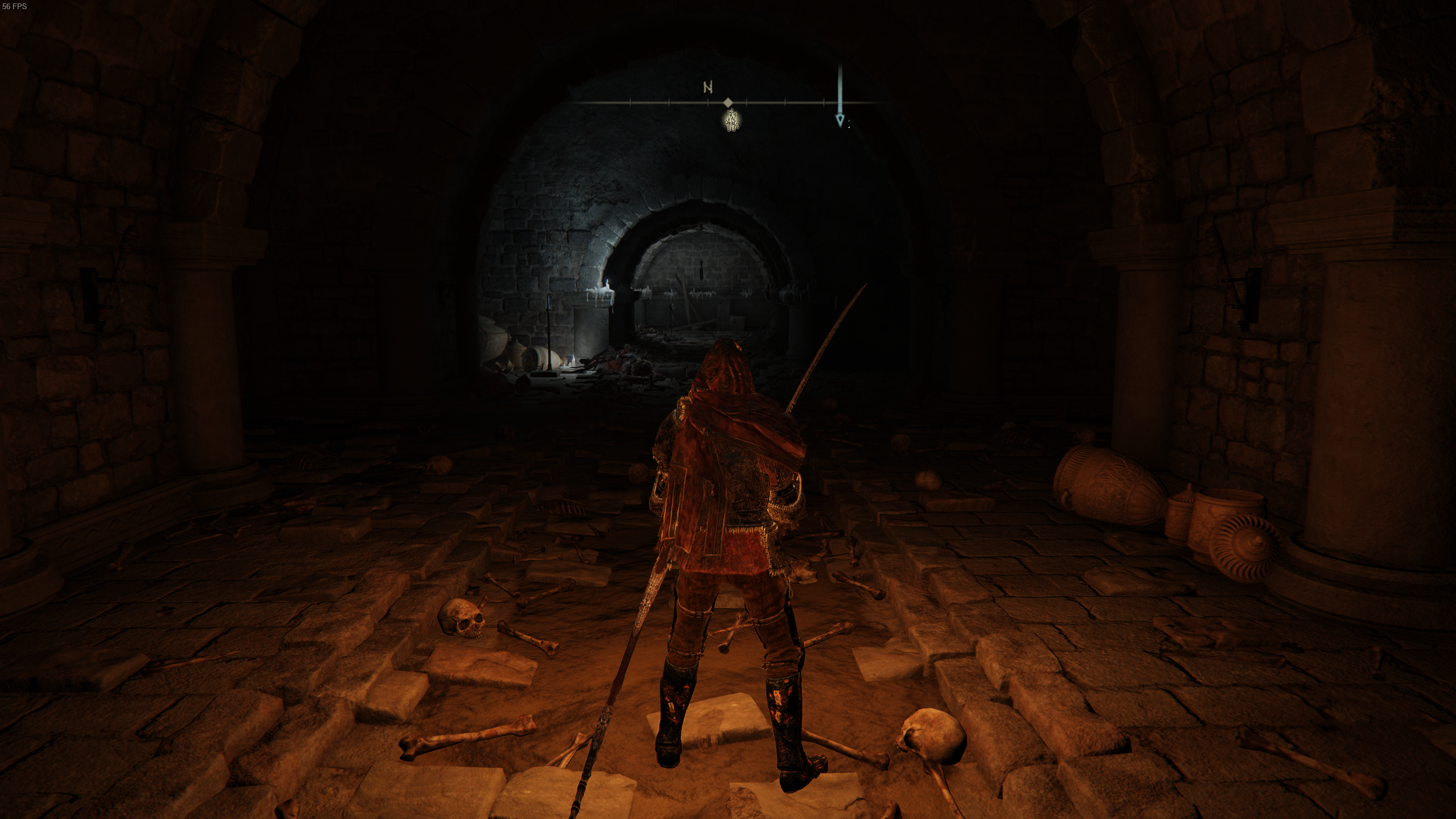
Ruins are rarely woven into environments, as remnants of whatever civilisation previously inhabiting that space cannot exist identified. Instead, these structures are made up of unproblematic assets placed into the world with the sole purpose of awarding players with a new item upon completion. And even when diving deep into one of its basements, all that's present is an empty room with a chest inside. The same can be said for the game's shacks, churches and towers, as they look like and typically exist to pad out the wilderness.
This certainly gives the role player something to exercise within the open-earth, but they rarely receive an exciting purpose or shift in artful. These sections tin exist repetitive, and while that's fine, it oft hinders the fantastic momentum presented by the game's best moments. A few churches, ruins and towers throughout the world can be interesting, making the potential of these structures clearer, whether that be because of the presence of a boss, unique NPC or a striking visual that you lot just won't expect.
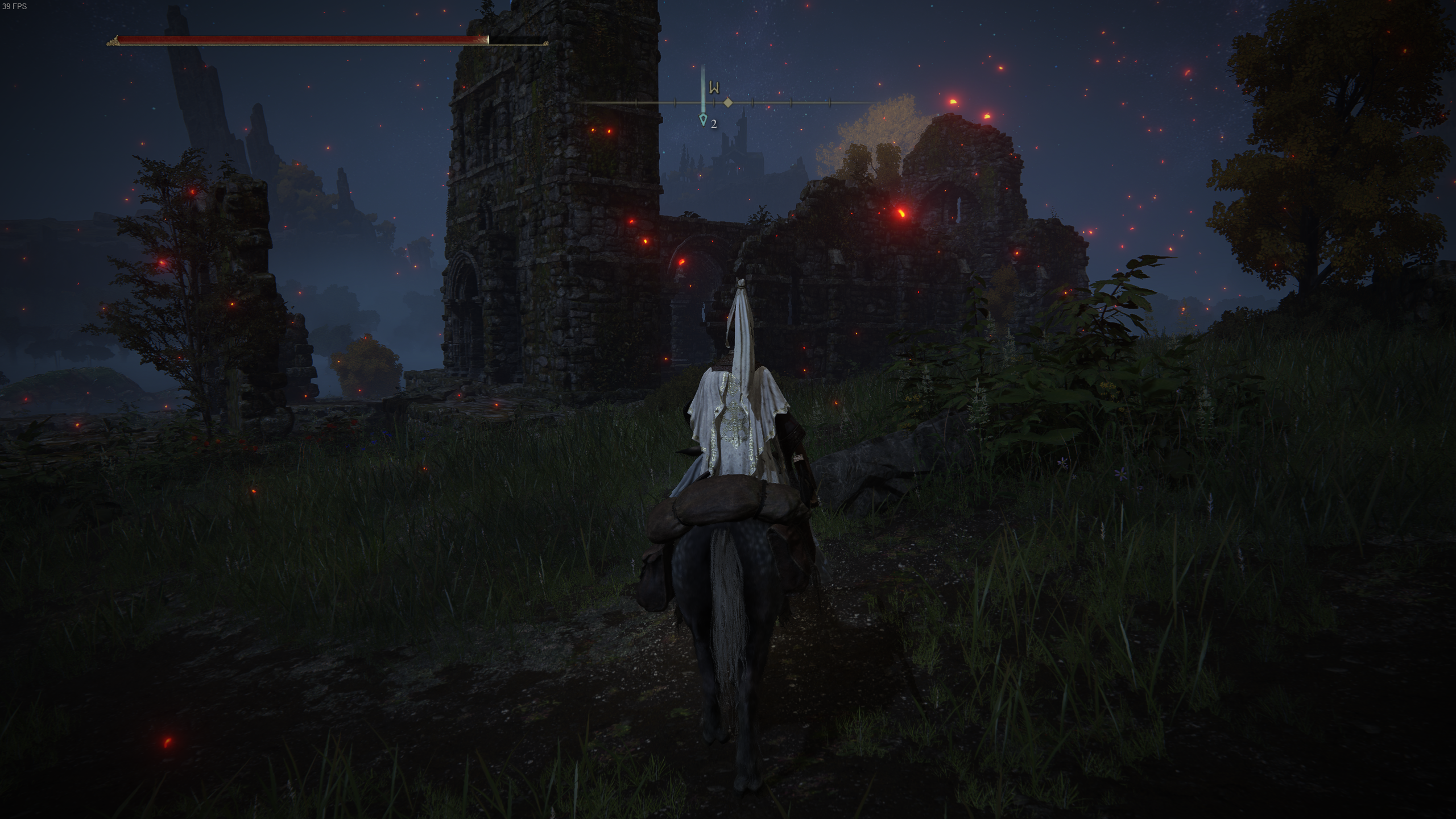
So much of The Lands Between is unique, but those moments when you're fighting a reused boss or trudging through another white, candlelit dungeon can be a slog. And while the world is full of diverse foes, the massive size simply ways you'll end up fighting besides much of everything. Expect to see behemothic crabs, bats, wolves, trolls, golems and plants roaming nearly every area, and even when yous idea y'all were already too sick of one type of enemy, it'll simply keep on coming back.
And although there are many unique bosses, information technology gets exhausting when you come across the fifth identical version of a specific type of boss yous detest. This wouldn't be a huge issue if information technology was limited to a select few, but most open up-world bosses in Elden Band are reused at least twice. This lack of variety can cause fatigue, especially in a series that is known for its inspired diversity.
This betrays the game'south initial promise. Limgrave has the histrion encountering a terrifying Tree Picket, screaming at the presence of a dragon crashing down upon a lake, and finding an undead mariner summoning skeletons throughout a distraught boondocks. This level of multifariousness within the game's showtime section gives rise to an expectation for future areas to proceed upwards that level of excitement. Yet inside the terminal expanse, every open up-globe dominate is rehashed. Elden Band boasts enough of diverse areas to explore, only these places are less thematically consistent when they don't avowal their own unique architecture, enemies and bosses.
Crafting repertoire
Elden Ring introduces crafting and cooking. Throughout the game, you'll hunt for meat and bones, or harvest leafage to collect plants and berries, and through the crafting card, you'll get the option to craft unique items. Arrows, perfumes, cured meat, throwing knives, boluses, grease and explosive pots are a few examples of what you can arts and crafts. There are many recipe books in the open up world to find, and the more you have, the more than y'all can arts and crafts.
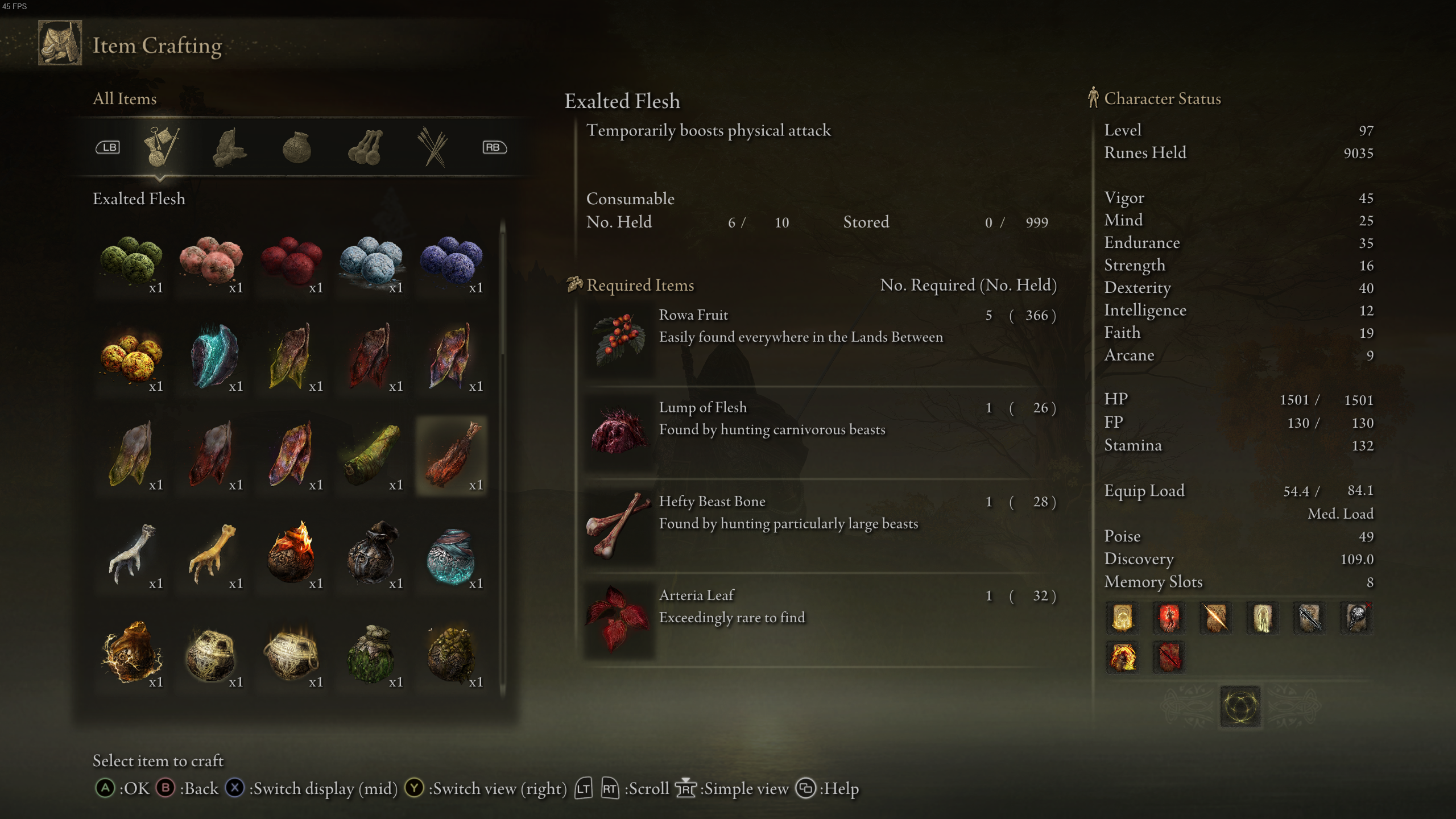
The items you craft are situational. Possibly a nest of clawed eagles are clumped together, and yous need to create some throwing knives to lure them out. Or maybe a specific boss keeps using a move that one-shots y'all, so you concoct a perfume that gives your grapheme a protective bubble to significantly reduce the damage of that 1 strike. Or perchance, in very typical Soulsborne way, you've accidentally stepped in green gunk for as well long so you lot rush into the crafting menu for some Neutralizing Boluses to cure your poisoned status.
Putting periphery items into a crafting menu is brilliant, as it means the treasures a player plunders inside the depths of catacombs tin exist more distinct. Additionally, it gives the player more command over their inventory, and so they have room to option out the nigh worthwhile bonus items. And if the player is scrounging to craft something specific, the material description volition inform them how to larn it. For example, if I wanted to arts and crafts a Sacred Order Pot, which would let me throw a pot that deals holy harm, 2 of its primary ingredients are a Gold Sunflower and a Gilt Centipede. When hovering over the recipe, the sometime is "establish virtually Minor Erdtrees," whereas the latter is "found most churches and similar." These descriptions can sometimes be a bit vague, but they usually assist a bunch when in need of things to arts and crafts.
Elden Band also introduces the Flask of Wondrous Physick, which is a potion that awards powerful buffs depending on the two boons mixed inside. This potion is infinitely reusable, and is restored when resting at a grace signal. My current Flask of Wondrous Physick enhances dodge rolls and increases stamina recovery rate. I tin can just drink this once between resting points, merely it's immensely helpful to use earlier a difficult boss. Other boons can increase specific element damage, protect the user confronting a single attack, or restore health.
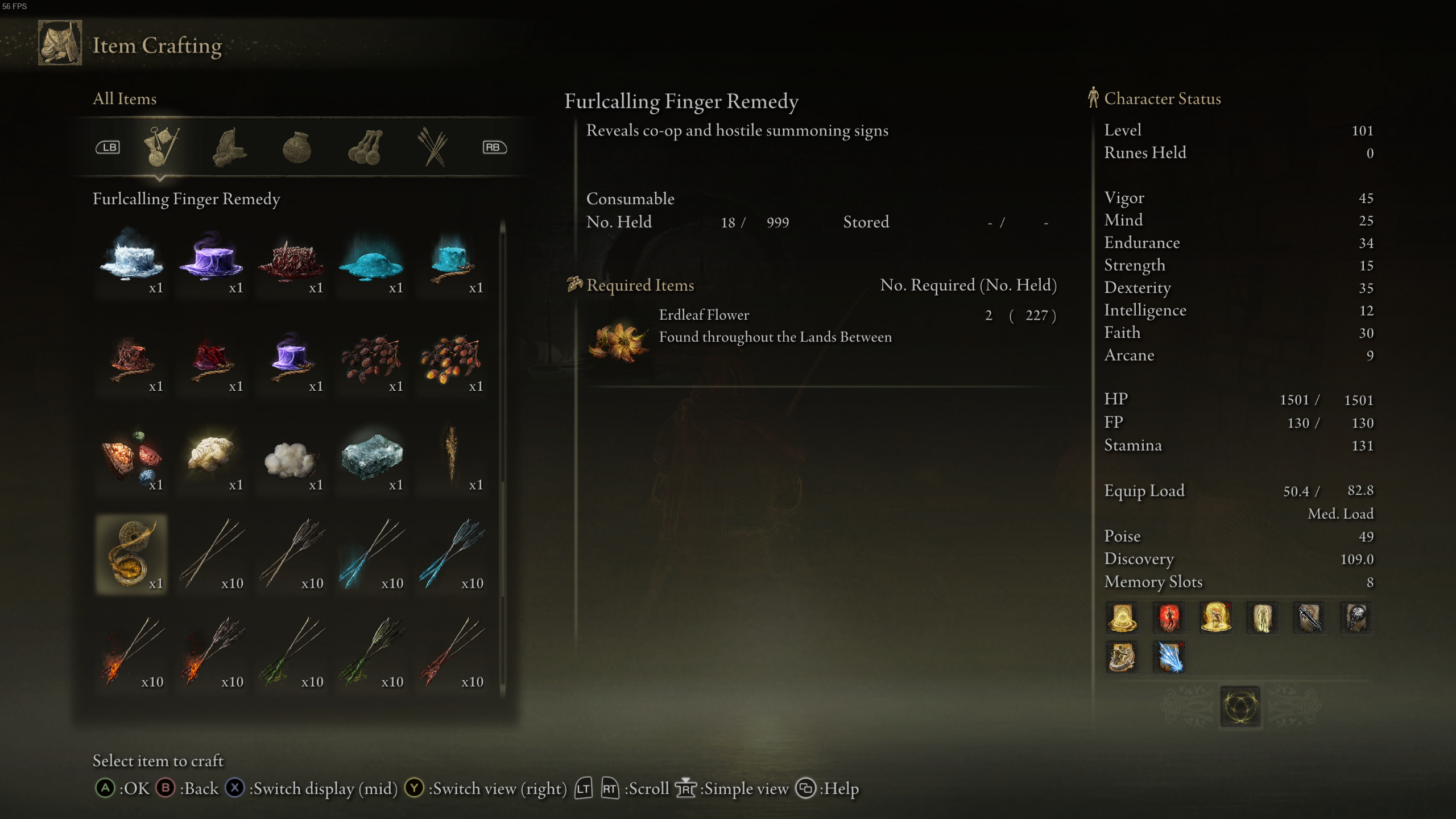
In the crafting menu is the Furlcalling Finger Remedy likewise, which is fabricated with a common leaf found in the open globe. This detail enables the player to see summon signs and initiate cooperative play. Since the textile to create this is and so abundant, it makes Elden Band the about convenient game to play cooperatively in the Soulsborne serial. And across just the convenience, the nature of its open up earth lends itself excellently to multiplayer.
Elden Ring encourages jolly cooperation
Demon'south Souls, Dark Souls and Bloodborne have quiet, but striking sound design, terrifying enemies, a sparse use of music, and a world overwhelmed with death. Every bit a result, I've never enjoyed hopping in a Discord phone call and group up with friends while knee-deep in a Soulsborne. Having someone by my side is antithetical to the feeling of loneliness that I yearn for when playing these games. And since areas are often claustrophobic, enemy encounters rarely feel appropriate in multiplayer.
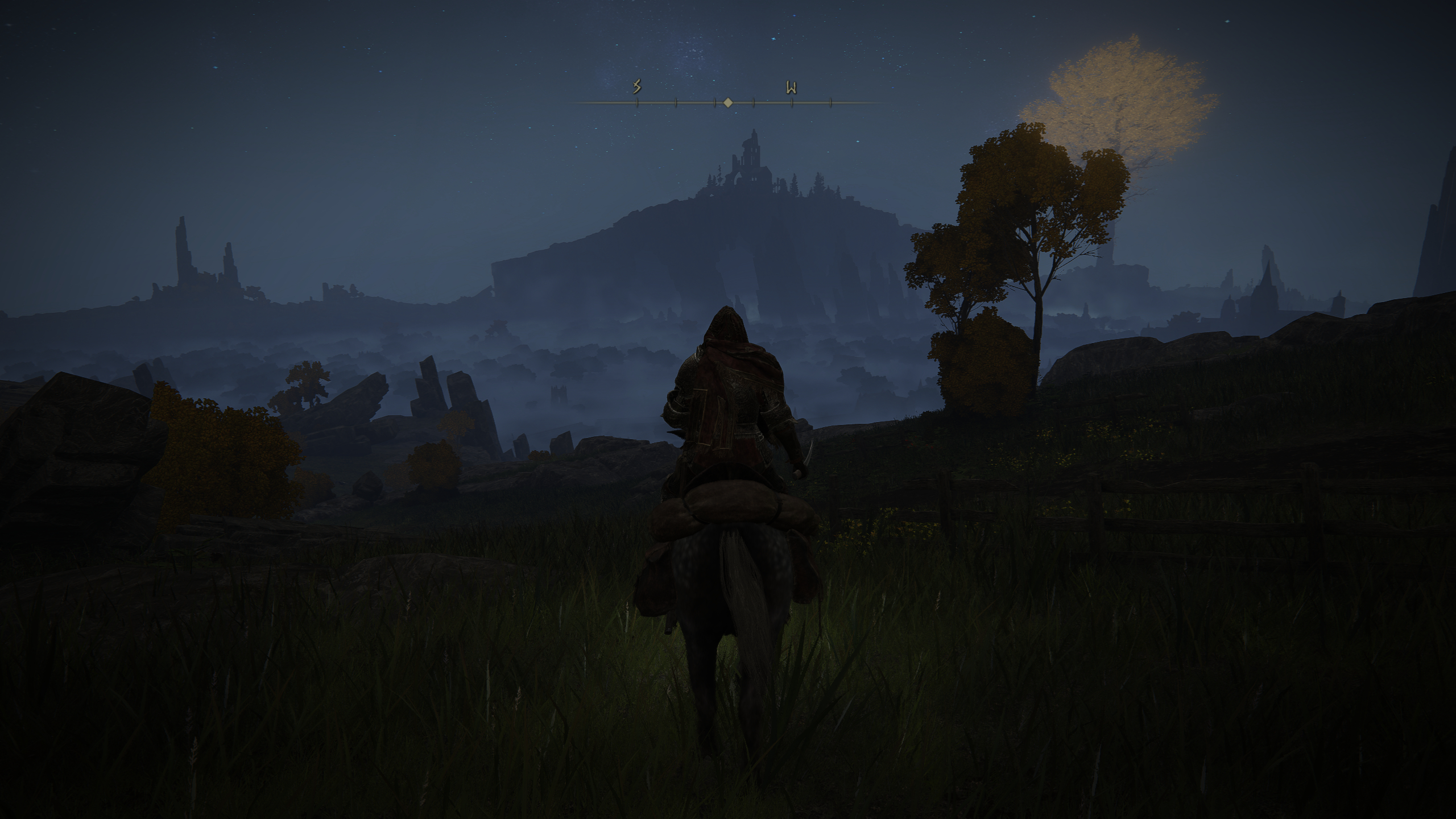
However, Elden Ring is different. The sound of metal boots clanking, the gusts of air current blowing through the grass, and the low crackling of fire is still the focus of the game's sound pattern, simply these great plains are imbued with life, boasting boars, rabbits and birds. Elden Ring is colorful and lush in a way that Nighttime Souls never was, and equally a result, exploring these vast plains feels advisable with a friend. I firmly believe this is the best Soulsborne to play with others.
Elden Ring PC operation
Elden Band doesn't have many bugs, but one I noticed is that the game crashed three times when teleporting to a site of grace. Additionally, I've noticed a few objects not loading correctly in the world. For instance, the gate mechanism in Stormveil Castle was completely invisible, and it glitched out equally my characters turned information technology. Otherwise, no other bugs noted.
Elden Ring has plenty of graphical settings that you tin can adjust. In the graphics tab, quality setting presets can be changed between maximum, high, medium and low. These alter SSAO, depth of field, and the quality of textures, antialiasing, movement blur, shadows, lighting, effects, volumetrics, reflection, water surfaces, shaders, global illumination, and grass.
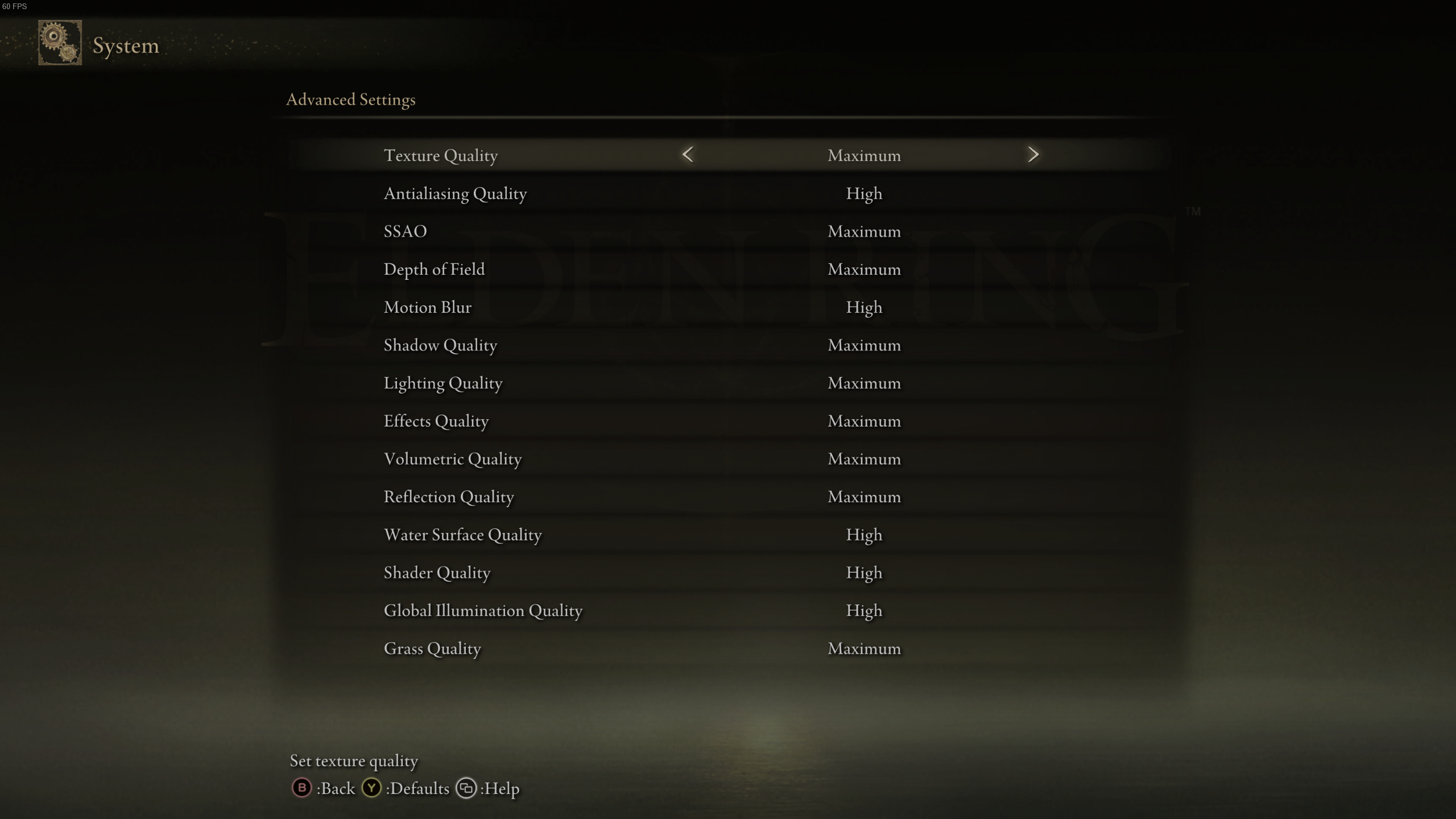
Unfortunately, Elden Ring does not support ultra-wide displays, and so your resolution volition be locked to xvi:9. This isn't new for FromSoftware games, just it sure would exist dainty if the company began thinking most expanding its resolution options.
Elden Ring PC benchmarks and requirements
I played Elden Ring using a desktop-level Nvidia GeForce GTX 1070 GPU with 8GB of VRAM, which is the recommended GPU requirement. With graphic settings at max and running at 2560 x 1440, I normally hovered between 40 to 50 frames per 2nd. When exploring tight spaces, the game stayed at a pretty consistent 60 fps. Yet, during a downpour in the open up world or intense boss fights, I'd occasionally experience stutter at 30 fps.
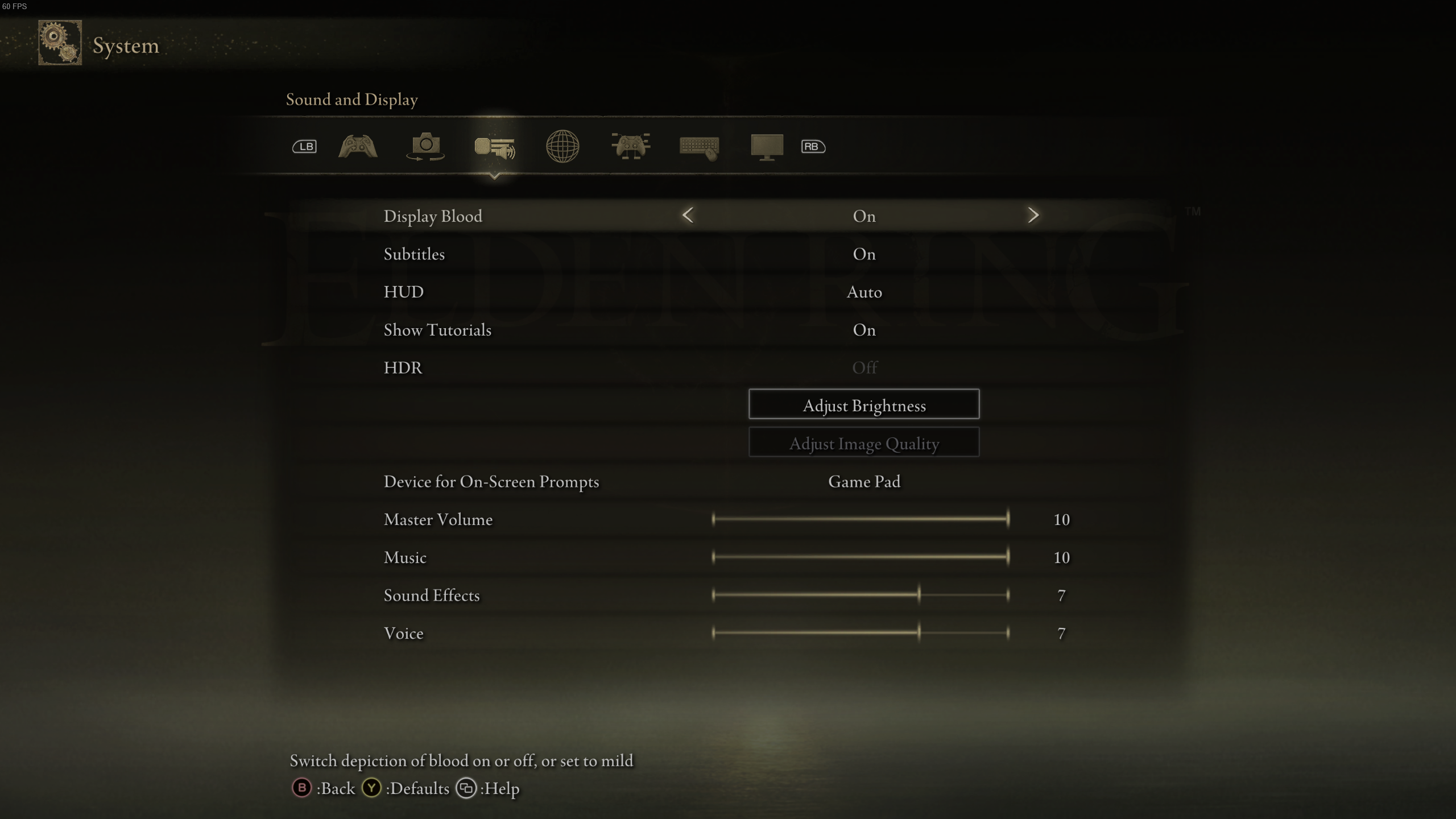
Playing at 1080p would boost that to around l to 55fps, and bringing the quality settings down to medium at 1080p gave me a consequent 60fps. However, this was absolutely non worth information technology for the quality loss.
Elden Ring'southward minimum requirements include an Intel Cadre i5-8400 or AMD Ryzen iii 3300X processor, 12GB of RAM, Nvidia GTX 1060 3GB or AMD Radeon RX 4GB GPU, and 60GB of storage infinite.
Elden Ring's recommended requirements include an Intel Core i7-8700K or AMD Ryzen 5 3600X processor, Nvidia GTX 1070 8GB or AMD Radeon RX Vega 56 8GB GPU, and 60GB of storage infinite.
Bottom Line
Elden Ring isn't as groundbreaking equally Demon's Souls was, nor is its globe as imaginative as Bloodborne's Yharnam. Instead, this is an amalgamation of the many things we beloved and wait out of FromSoftware, tossed into an open world packed with breathtaking sights and exciting encounters. Information technology's besides the squad'southward virtually intricate RPG yet, offering immense build diversity and a slew of captivating quest lines.
If y'all were hypnotized by the wondrous curiosity Breath of the Wild evoked in 2017, The Lands Between will similarly demark you lot. It's a shame the feel is weighed down by bland mini-dungeons, rehashed boss fights and passable enemy diversity, but these faults are redeemed by the grandest moments this series has to offer.
Elden Ring is FromSoftware's latest flawed masterpiece. While far from perfection, it's the best open earth game I've played and a substantial contender for game of the year.
Source: https://www.laptopmag.com/uk/reviews/elden-ring
0 Response to "Elden Ring More Than One Character"
Post a Comment